Blog

  • Puer Aeternus: Jung’s Archetype of the Eternal Boy

    Two thousand years before anyone applied it to a grown man who wouldn’t commit to a job, a marriage, or a city, puer aeternus was a line of poetry addressed to a god.

    Ovid wrote it in Metamorphoses, around 8 CE, in a hymn to the child-god Iacchus — later identified with Bacchus and Dionysus: tu puer aeternus, tu formosissimus alto conspiceris caelo. “You, eternal boy, are seen as the most beautiful figure in the height of heaven.” It is the earliest surviving use of the phrase, and it is not describing a psychological type. It is praising a god of vegetation and resurrection, forever young because gods do not age.

    The person who did the most to carry that phrase from a Roman hymn into a clinical vocabulary was not Jung himself, primarily. It was Marie-Louise von Franz — his closest collaborator for almost thirty years, from the day she met him in 1933 until his death in 1961 — in a set of lectures she delivered at the C.G. Jung Institute in Zurich in the winter of 1959–60. They were published a decade later, in 1970, as the book almost everyone means when they say “the puer aeternus book.”

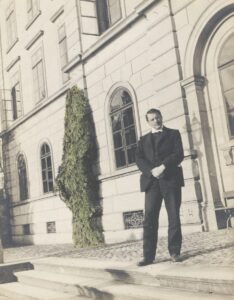
    Portrait photograph of Antoine de Saint-Exupéry, taken around 1920.
    Saint-Exupéry around 1920, some twenty-three years before he wrote The Little Prince and twenty-four before his final flight. Marie-Louise von Franz built her case for puer aeternus around this book and the man who wrote it. Photographer unknown, via Wikimedia Commons. Public domain.

    The timeline, in one place

    When What
    c. 8 CE Ovid, Metamorphoses, Book 4: the child-god Iacchus praised as puer aeternus
    1900 Antoine de Saint-Exupéry born, Lyon
    1933 Marie-Louise von Franz meets Jung; begins a collaboration that lasts until his death
    1943 Saint-Exupéry publishes The Little Prince
    31 July 1944 Saint-Exupéry disappears on an unarmed reconnaissance flight over the Mediterranean
    Winter 1959–60 Von Franz delivers the Puer Aeternus lectures at the C.G. Jung Institute, Zurich
    1961 Jung dies
    1970 Von Franz’s lectures published as Puer Aeternus (Spring Publications)
    1983 Dan Kiley publishes The Peter Pan Syndrome — a separate, non-Jungian pop-psychology label
    May 2000 A diver locates wreckage off the coast of Marseille
    7 April 2004 French underwater archaeologists confirm the wreck as Saint-Exupéry’s aircraft

    Jung named it. Von Franz built the case file.

    Jung used the term in passing, as part of his broader habit of borrowing figures from mythology to name recurring psychological patterns — the same method that produced anima, shadow, and senex. He did not build it into a sustained clinical study on its own. These were also the years Jung was sitting, as he had for decades, on the far more elaborate confrontation with his own unconscious recorded in Liber Novus — still unpublished, and would remain so for another half-century.

    Von Franz did. Across twelve lectures — the first eight a close reading of The Little Prince, the last four a parallel reading of a now-obscure novel by Bruno Goetz, The Kingdom Without Space — she laid out what she saw as the recognisable shape of the type: a man (or, less centrally in her lectures, a woman: the puella aeterna) whose imagination stays fixed on flight, possibility, and the refusal of any single, binding choice, at the cost of the ordinary adult work of landing somewhere and staying.

    The man she built it around

    Von Franz did not pick Saint-Exupéry’s book as an illustration. She read it as the primary evidence.

    The Little Prince belongs to no planet; he visits several, refuses to commit to any, and returns to his own star by way of what the book stages as a kind of willed, gentle death. Von Franz’s lectures work through the story in that light — not as a children’s fable but as a document of the same psychological structure she was describing in her patients.

    What she could not have built into her 1959–60 lectures, because it hadn’t happened yet, is how closely the author’s own ending would rhyme with it. On 31 July 1944, Saint-Exupéry took off from an airstrip in Corsica in an unarmed Lockheed F-5 reconnaissance plane, on a mission to observe German troop movements ahead of the Allied invasion of southern France. He did not come back. The wreckage went unfound for fifty-six years, located by a diver in May 2000 and confirmed as his aircraft by France’s underwater archaeology department on 7 April 2004. No trace of combat was found on it. The most likely explanation offered since is mechanical failure — but that remains an inference, not a finding.

    What it isn’t: the Peter Pan mix-up

    Puer aeternus is routinely used online as if it were interchangeable with “Peter Pan syndrome.” The two are related but not the same thing, and the difference is not just branding.

    “Peter Pan syndrome” comes from a specific, dateable source: the psychologist Dan Kiley’s 1983 book The Peter Pan Syndrome: Men Who Have Never Grown Up. It is a popular-psychology label, coined more than a decade after von Franz’s lectures were published, with no basis in archetype theory and no claim to clinical diagnostic status. Puer aeternus, by contrast, sits inside Jung’s specific theoretical apparatus — archetypes as recurring patterns inherited through the “collective unconscious,” identifiable by their recurrence across myth, literature and clinical material alike. Kiley’s book borrowed the same cultural image — a man who won’t grow up — and gave it a catchier name. It did not extend von Franz’s argument; it ran alongside it.

    The counterpart nobody asks about: puella aeterna

    Puella aeterna is the term’s female counterpart — a woman whose psychological development shows the same pattern of arrest. It appears far less in both the literature and, today, in search volume (a few hundred monthly searches against several thousand for the masculine form). That imbalance is partly a fact about von Franz’s own lectures, which are built almost entirely around a male case study, and partly a symptom of the era producing them: the mid-century Jungian literature had a narrower, more gendered idea of what “growing up” was supposed to look like for a woman than for a man. Later commentators have made that point explicitly; it is worth stating plainly rather than treating the 1959–60 framework as a neutral, timeless description.

    Where to check this for yourself

    What is still unclear

    Two things, at least.

    The cause of Saint-Exupéry’s crash was never established. No evidence of aerial combat was found on the wreckage; mechanical failure is the most commonly offered explanation, but it is an inference from the absence of other evidence, not a confirmed cause.

    And the precise boundary between what Jung himself wrote about the puer figure and what von Franz added is not sharply drawn in the secondary sources this article draws on. Settling that would mean tracing Jung’s own scattered references across the Collected Works directly, rather than through summaries of them — work this site has not yet done.

    Where this site cannot verify something, it says so rather than filling the gap.

  • The Red Book: Jung’s Liber Novus

    For most of the twentieth century the Carl Jung Red Book sat in a bank vault in Zurich, and almost nobody had read it. Jung himself called it Liber Novus.

    It appeared in bookshops on 7 October 2009: an oversized facsimile, published by W. W. Norton, edited and co-translated by the historian Sonu Shamdasani. Jung had been dead since 1961. The book he had worked on for roughly sixteen years reached the public forty-eight years after the man who wrote it.

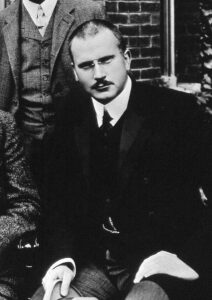
    Studio portrait photograph of Carl Gustav Jung, taken around 1935.
    Jung around 1935, some five years after he stopped working on Liber Novus. The photograph is held by the ETH-Bibliothek in Zurich — the same institution whose Jung papers Deirdre Bair was permitted to use, and which is not the family archive that was closed to her. Public domain.

    What it physically is

    Jung’s own title for the work was Liber Novus — “New Book.” The name everyone uses instead comes from its binding: red leather.

    It is not a manuscript in the ordinary sense. Jung composed the text between about 1914 and 1930, then transcribed it into a large folio volume in a deliberately antique calligraphic hand, and illuminated it with his own paintings: mandalas, figures, landscapes that are not quite landscapes. It looks less like a psychiatrist’s notebook than like a medieval illuminated manuscript made by someone who had studied how medieval illuminated manuscripts were made.

    That physical fact matters when you read it. Whatever else Liber Novus is, it is an object Jung laboured over for years, in a form he chose on purpose.

    What is in it

    The material began in the period after Jung’s break with Freud, when he undertook what he later described as a deliberate confrontation with his own unconscious. He recorded the visions and inner dialogues that followed in a set of small notebooks — the Black Books — and then worked that raw material into the elaborate text and images of Liber Novus.

    The book is where the concepts he later published in academic language first appear in their original, undomesticated form. Readers coming to it from the Collected Works often find the experience disorienting for exactly that reason: the ideas are recognisable, but the register is not scholarly at all.

    Why the Carl Jung Red Book stayed in the vault

    Two fears kept it there, and they were not the same fear.

    Jung’s own worry, by most accounts, was that readers would take the book as evidence that he had lost his mind — that a psychiatrist who recorded his own visions at this length would not be read as a psychiatrist afterwards. His estate’s concern, held long after his death, was closely related but more institutional: that publishing it would damage his standing as a scientist.

    So the manuscript went into a safe deposit box, and for decades the family declined to release it. Access was granted rarely and narrowly. The decision to publish came only after long negotiation, and the edition that resulted took Shamdasani years of work, supported by the Philemon Foundation, which exists to publish Jung’s unpublished works.

    The biography written without it

    Here is the part that is usually left out of accounts of the Red Book, and it is worth stating plainly.

    The standard English-language life of Jung — Deirdre Bair’s Jung: A Biography, 881 pages, Little, Brown, 2003 — was researched and written by someone the family would not allow to read the Red Book.

    Bair worked in the Jung papers held at the ETH in Zurich under the standard terms offered to scholars. What she was not given was the family archive. Reported among the material closed to her: Jung’s private diaries, his mother’s diaries, and roughly a thousand letters between Jung and his wife Emma.

    So the biography that shaped the English-speaking picture of Jung for a generation was written with a hole at its centre — and the person who edited the document in that hole became, six years later, one of the biography’s sharpest critics.

    The Shamdasani dispute

    Shamdasani published a detailed critique of Bair’s biography, working through specific claims and identifying what he considered errors of fact and interpretation. Several of his objections turn on precisely the point above: that material in the family archive contradicted assertions Bair had made, and that this would become clear once the Red Book appeared.

    Bair replied publicly, in an open letter addressed to him.

    This site does not adjudicate that exchange. It is worth knowing about for a practical reason: if you are reading Bair’s Jung today, you are reading a book written before the most important primary source was available, by an author who was refused access to it, and which a scholar with that access has publicly disputed. None of that makes the biography worthless. It does mean it should be read as one account rather than as the settled record.

    Carl Jung Red Book cover: The Red Book, Liber Novus, edited by Sonu Shamdasani.
    The Red Book: Liber Novus, W. W. Norton, 2009, edited and co-translated by Sonu Shamdasani. Cover image courtesy of W. W. Norton & Company.

    How to approach it

    • The full facsimile edition reproduces the pages as objects, with the paintings, alongside translation and Shamdasani’s apparatus. It is large, heavy and expensive, and it is the version that shows you what the book actually is.
    • The Reader’s Edition carries the text and the notes without the facsimile plates. Cheaper, portable, and a reasonable way in — but the images are not decoration, and reading the text alone gives you a partial object.
    • Do not start here if you are new to Jung. Memories, Dreams, Reflections or Modern Man in Search of a Soul give you the vocabulary first. Liber Novus assumes you already have it.

    Where to check this for yourself

    Nothing on this page should be taken on trust. The publication history and editorial apparatus are documented by the Philemon Foundation, and Pacifica Graduate Institute maintains a library guide to the Red Book that lists the editions and the secondary literature. Where this site departs from those sources, it says so.

    What is still unclear

    Two things, at least.

    The first is how much of the Black Books material Jung reworked, softened or dropped on the way into Liber Novus. The notebooks were published separately and later; comparing the two is scholarly work that is still in progress.

    The second is the internal history of the family’s decision-making across five decades — who argued for publication, who against, and when the balance shifted. Accounts of this exist, but they are partial and they come from interested parties.

    Where this site cannot verify something, it says so rather than filling the gap.