
This page is, by necessity, a gallery with most of the pictures missing. Carl Jung’s most striking visual work — the mandalas and painted figures in The Red Book — remains under copyright until 2031. What follows describes what exists, in words, and points to the few places you can legally see the images themselves.
The timeline
| When | What |
|---|---|
| 1913–c. 1930 | Jung composes and illustrates Liber Novus (The Red Book), transcribing and painting it into its final form over roughly a decade of that period |
| 1922 | Jung buys land at Bollingen, on Lake Zurich, after his mother’s death |
| 1923 | Builds the first, round section of the Bollingen Tower |
| 1927, 1931, 1935 | Adds three further sections, by hand, over the following years |
| 1950 | Carves the Bollingen Stone for his 75th birthday, after a quarry mistakenly delivered a stone cut to the wrong dimensions |
| 7 Oct 2009 – 25 Jan 2010 | The Red Book’s original pages go on public display for the first time ever, at the Rubin Museum of Art, New York |
| 11 Apr – 6 Jun 2010 | The exhibition travels to the Hammer Museum, Los Angeles |
Why you won’t see the paintings themselves here
Jung died in 1961; under the copyright terms that apply to his work, his paintings and illustrations remain protected until 2031, seventy years after his death. This site does not have permission to reproduce them, and has chosen not to lift them from elsewhere. If you want to see the actual pages — the mandalas, the figures, the deliberately antique calligraphy described in our piece on the Red Book itself — the legitimate routes are the facsimile edition published by W. W. Norton, and the record of the 2009–2010 exhibitions that first put the originals in front of the public.
Not a trained painter, and not trying to be one
Jung had no formal art training, and made a point of saying so did not matter. The technique he was practising — he called it active imagination, developed between roughly 1913 and 1916 during the period he later described as his “confrontation with the unconscious” — asked patients (and, extensively, himself) to give visual form to dream and fantasy material regardless of skill. To the objection “I am not a painter,” his answer was that most modern painters were not painters in the traditional sense either, and that the point was never technical or aesthetic success. The point was letting the fantasy take form on the page at all. Read as fine art, the Red Book paintings can look startling in their ambition for someone with no training. Read as clinical self-experiment, that is closer to the intention behind them.
The tower he built by hand
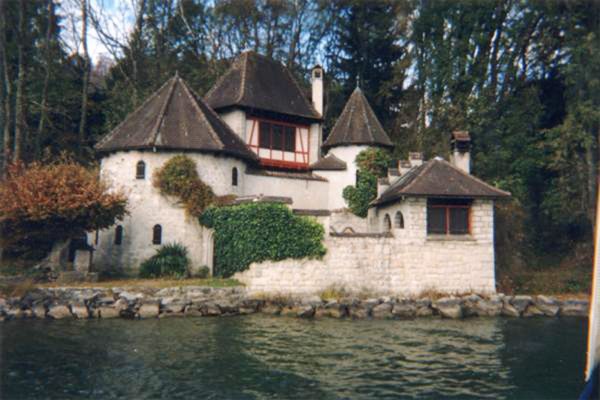
In 1922, following his mother’s death, Jung bought land at Bollingen, on the upper shore of Lake Zurich. He built the first section of a round stone tower there in 1923 and kept adding to it — new sections in 1927, 1931 and 1935 — using techniques of stonemasonry he taught himself for the purpose. By the mid-1930s it had grown into a four-part retreat with no electricity or running water, where Jung spent progressively more time working, and which he described as a kind of building in stone of his own process of psychological development.
The stone that arrived by mistake
In 1950, for his 75th birthday, Jung had a stone delivered from a quarry for use in the tower’s grounds. It arrived cut to the wrong dimensions — a cube roughly twenty inches on a side, not the shape he had ordered. Rather than send it back, he kept it: “That is my stone, I must have it.” He carved it himself over time, inscribing it on multiple faces — a Latin verse from the alchemical Rosarium philosophorum on one side, a Greek-inscribed image of Telesphorus (an ancient minor healing deity, shown hooded and cloaked, carrying a lantern) on another. It remains at Bollingen today. Because it is a sculptural work by Jung rather than a photograph of the tower’s exterior, the same copyright restriction that applies to the paintings applies to reproductions of it, and no image of the stone itself appears on this page.
Where to check this for yourself
- Wikipedia’s sourced account of The Red Book, including its exhibition history.
- The Hammer Museum’s own 2010 press release for the Los Angeles leg of the exhibition.
- Wikipedia’s entry on the Bollingen Tower, with construction dates and sourcing.
What is still unclear
The exact quarry, and the specific chain of events that led to a wrongly-cut stone reaching Jung in 1950, is recounted consistently across secondary sources but this site has not traced it to a primary document in Jung’s own hand. And the precise years in which individual Red Book pages were painted, as opposed to the text being drafted, are not fully disentangled in the sources available here.
Where this site cannot verify something, it says so rather than filling the gap.
Leave a Reply